Laser cooling molecules for quantum simulation
Our team is building an experiment to cool calcium monofluoride (CaF) molecules to within a millionth of a degree of absolute zero, trap them with laser beams, and use them to explore quantum physics that is too hard to compute classically.
Join the team Our research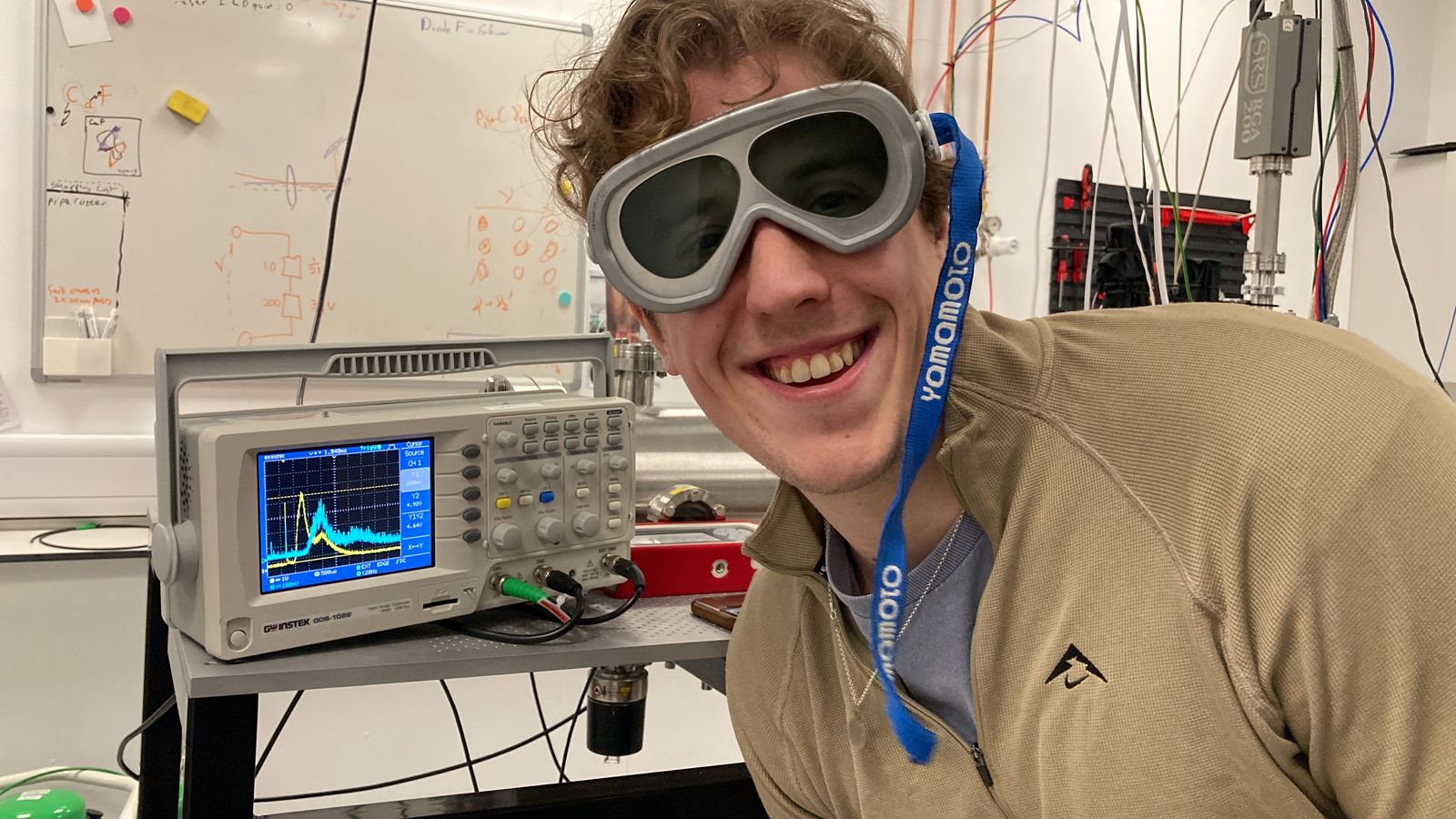
Why molecules?
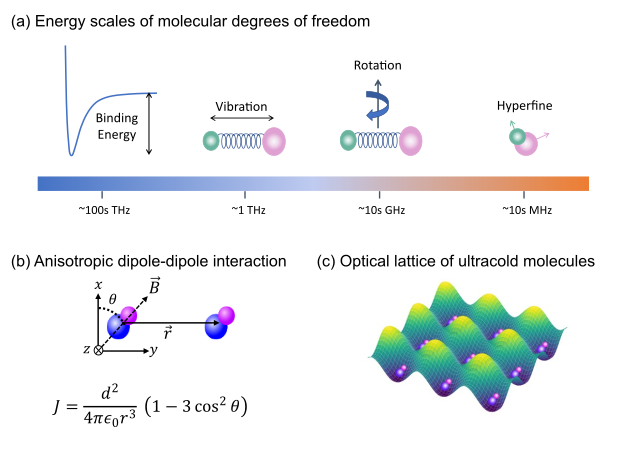
The study of ultracold atomic gases extends back around 40 years, and has led to remarkable advances in our understanding of quantum physics. Expanding the ultracold toolkit to molecules promises exciting opportunities to go beyond what is possible with atoms. Molecules possess extra degrees of freedom which span many orders of magnitude in energy, these include vibrational and rotational structure which provide a basis for precision measurement, tests of fundamental physics and the study of quantum chemistry. Polar molecules also experience long-range, anisotropic dipole-dipole interactions which can be used to study many-body physics, or controlled to set up quantum simulations or quantum computation. An optical lattice of ultracold polar molecules is an ideal testbed for many of these applications, and this is the goal of our lab.
Quantum simulation
Arrays of interacting molecules can mimic models of quantum magnetism, helping us understand systems that classical computers struggle to describe.
Optical lattice
A retro-reflected laser beam sets up a standing intensity wave, ultracold molecules can be pinned to the intensity minima (or maxima).
Laser cooling
To be trapped, the molecules must be extremely cold (microkelvin), this can only be achieved by using lasers to remove energy.
How our experiment works
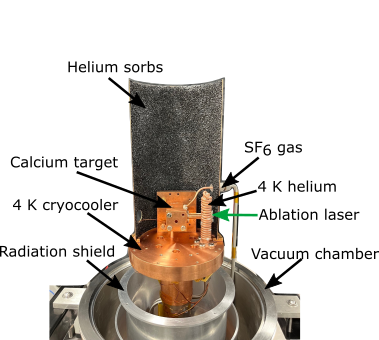
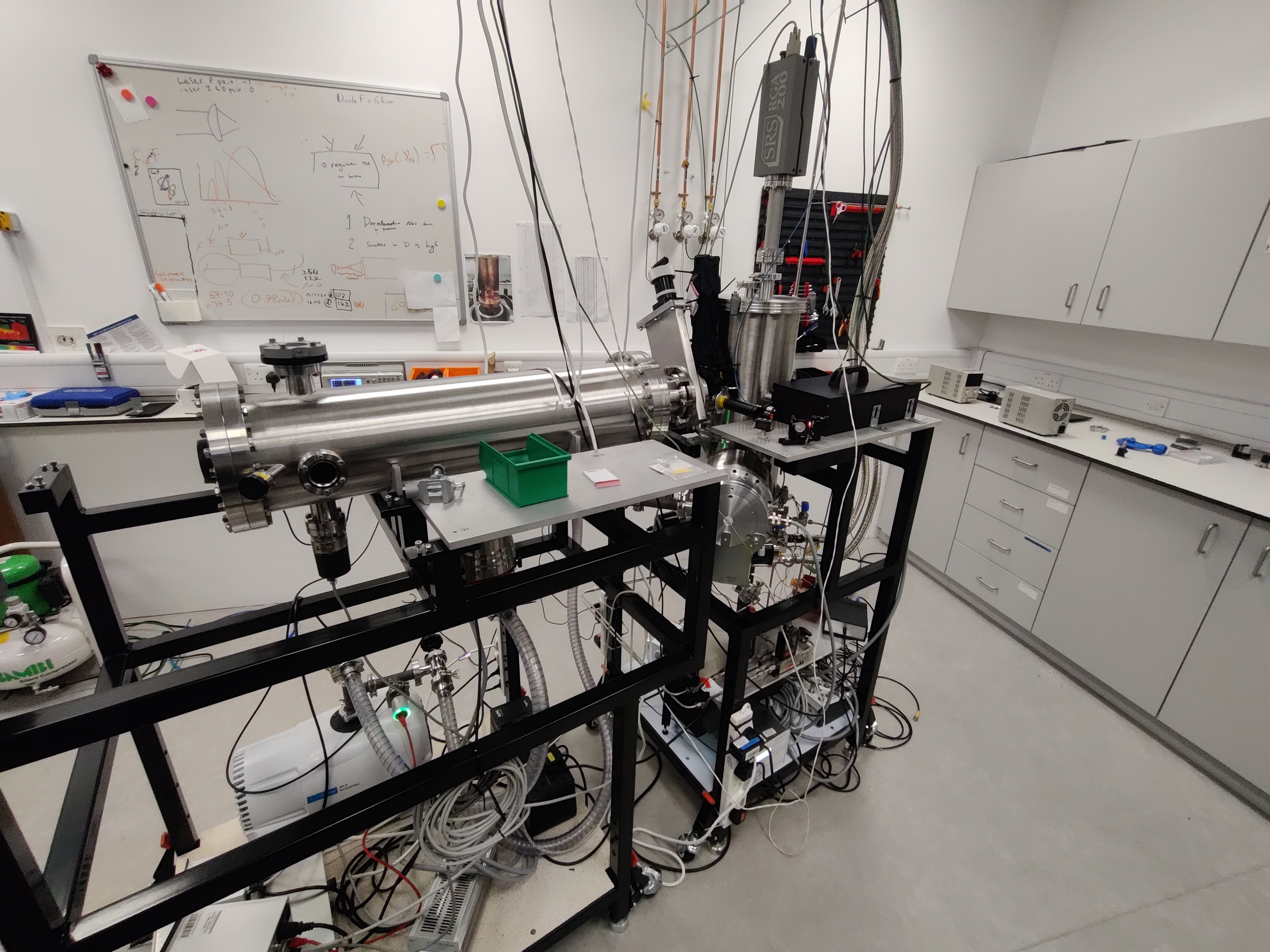
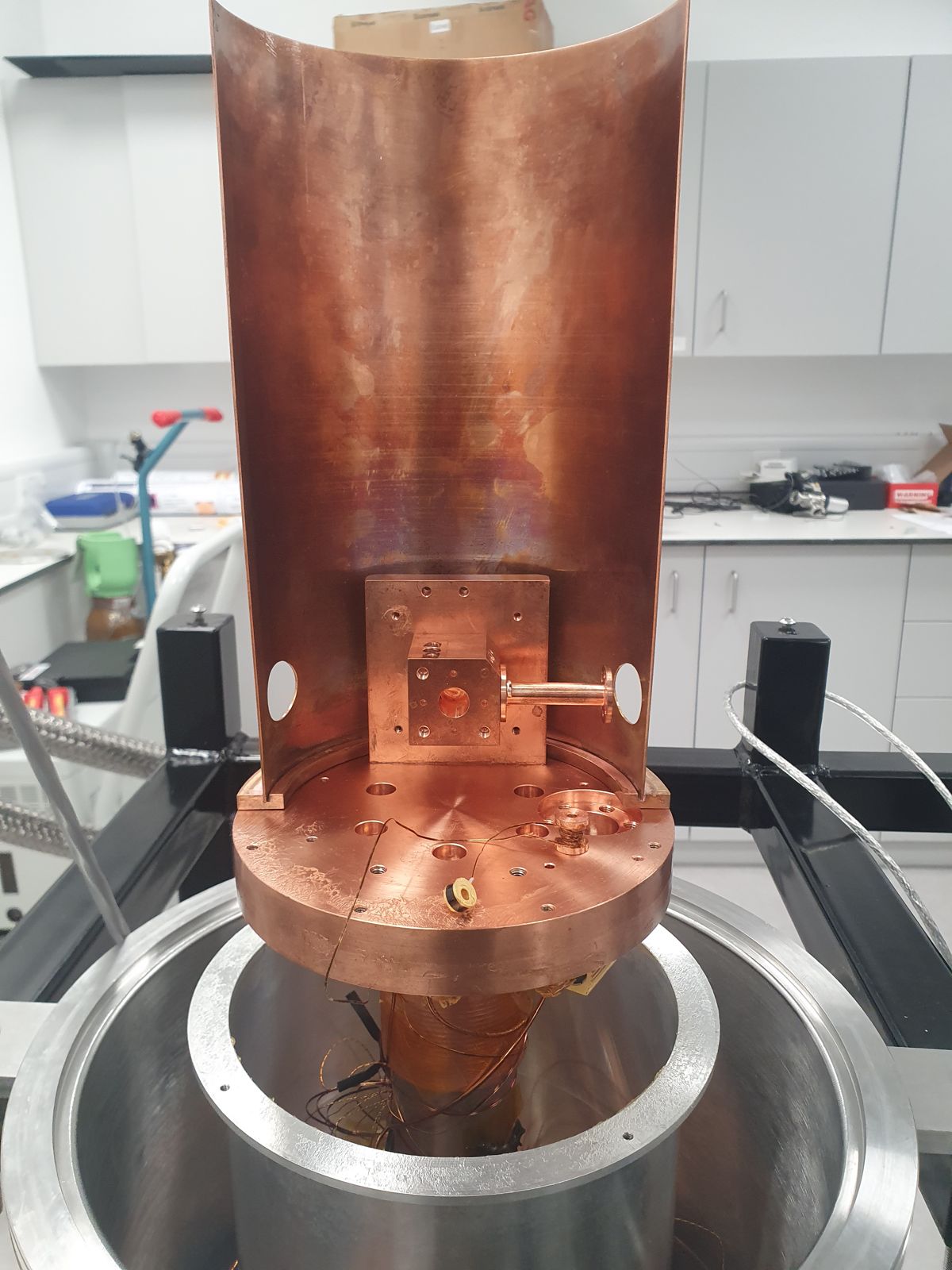
1. Making the molecules. Every laser cooling experiment starts by creating molecules. We use a pulsed Nd:YAG laser to ablate a calcium metal target, creating a plasma of Ca ions. Sulfur hexafluoride gas is injected, which reacts with the calcium to form CaF. This happens inside a copper cell cooled to 4 K, cold helium gas also flows into the cell and cools the molecules. The cold CaF molecules then leave the cell as a beam travelling at around 150 m/s.
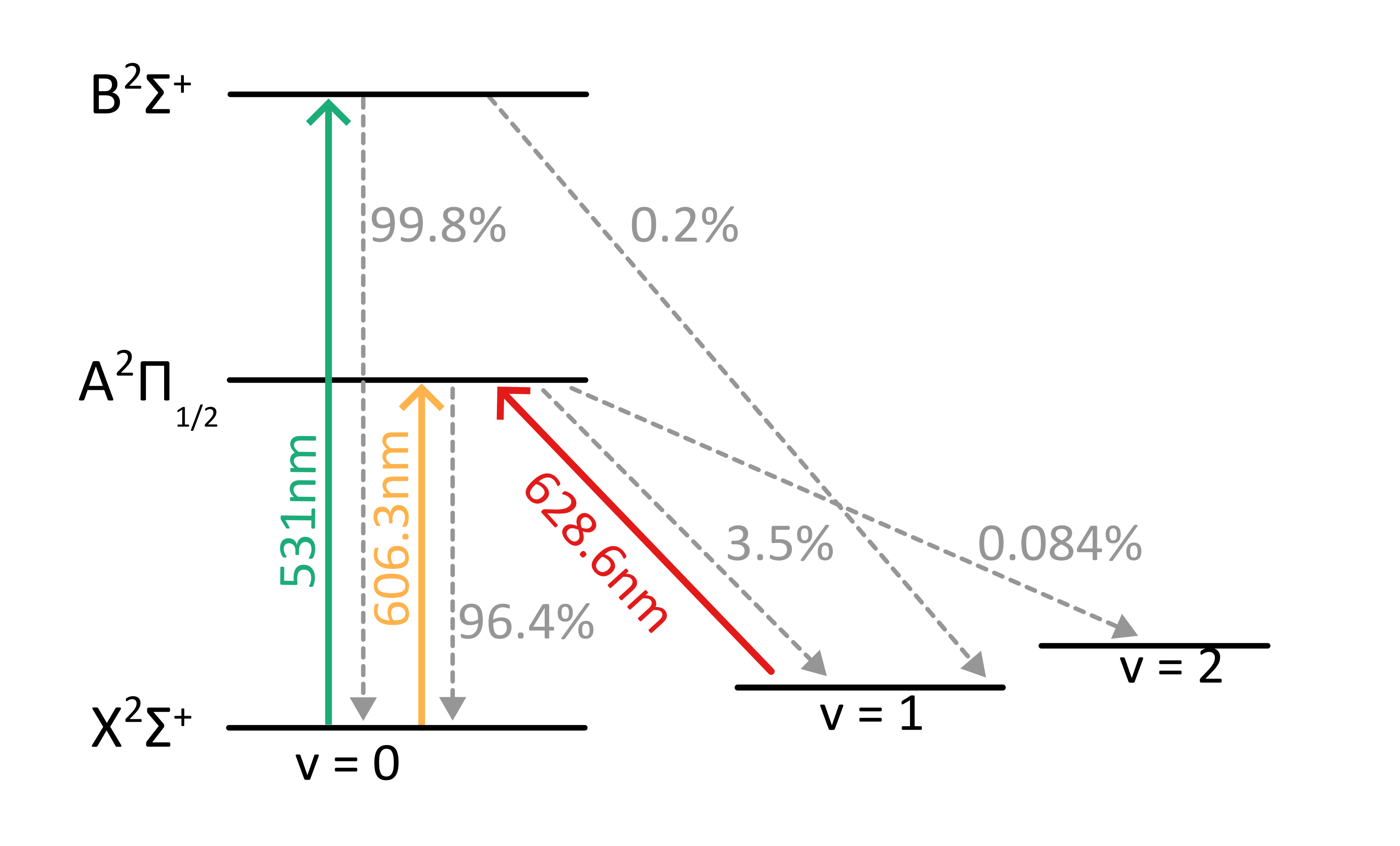
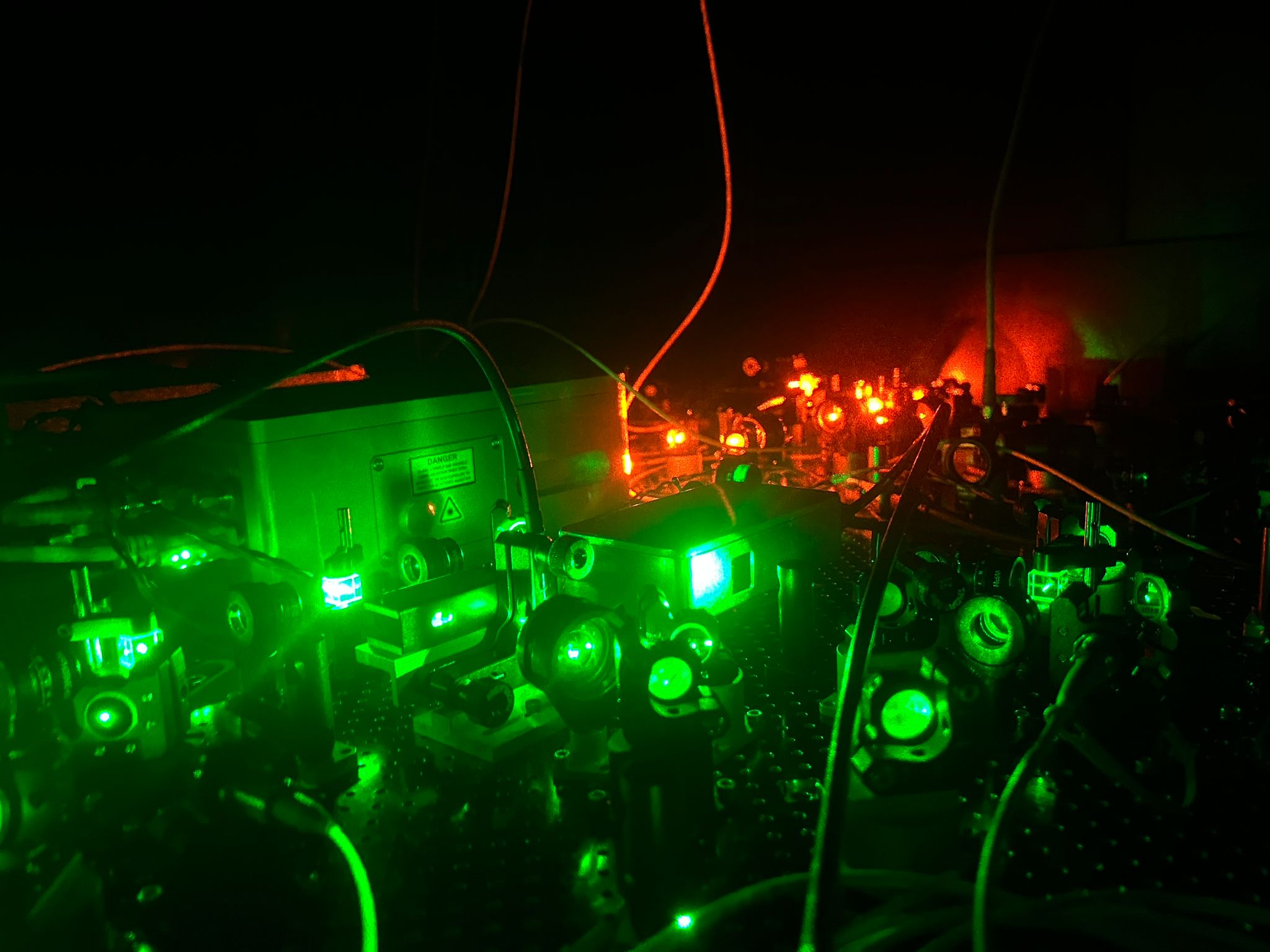
2. Slowing them down. 150 m/s is far too fast to trap, so we need to decelerate the molecules. CaF has been chosen because of its nice structure, it has two electronic transitions which are almost closed (X (ground state) to A (1st electronic state) at 606 nm and (X to B (2nd electronic state)) at 531 nm. We use the X-B transition for laser slowing and counterpropagate a 531 nm laser which is detuned to be resonant with fast molecules. We then sweep (chirp) its frequency to stay on resonance with the molecules and they slow down and their Doppler shift changes.
3. Trapping and cooling. Next we will capture the slowed molecules in a magneto-optical trap (MOT), cool them further, and load them into optical tweezer arrays and lattices for quantum simulation. We are in the process of building the chamber for the MOT.
Our progress so far
- October 2021The group is foundedWe begin planning our experiment.
- September 2022New lab completedAn office space converted into our lab.
- April 2024First CaF moleculesWe see our first molecular signal.
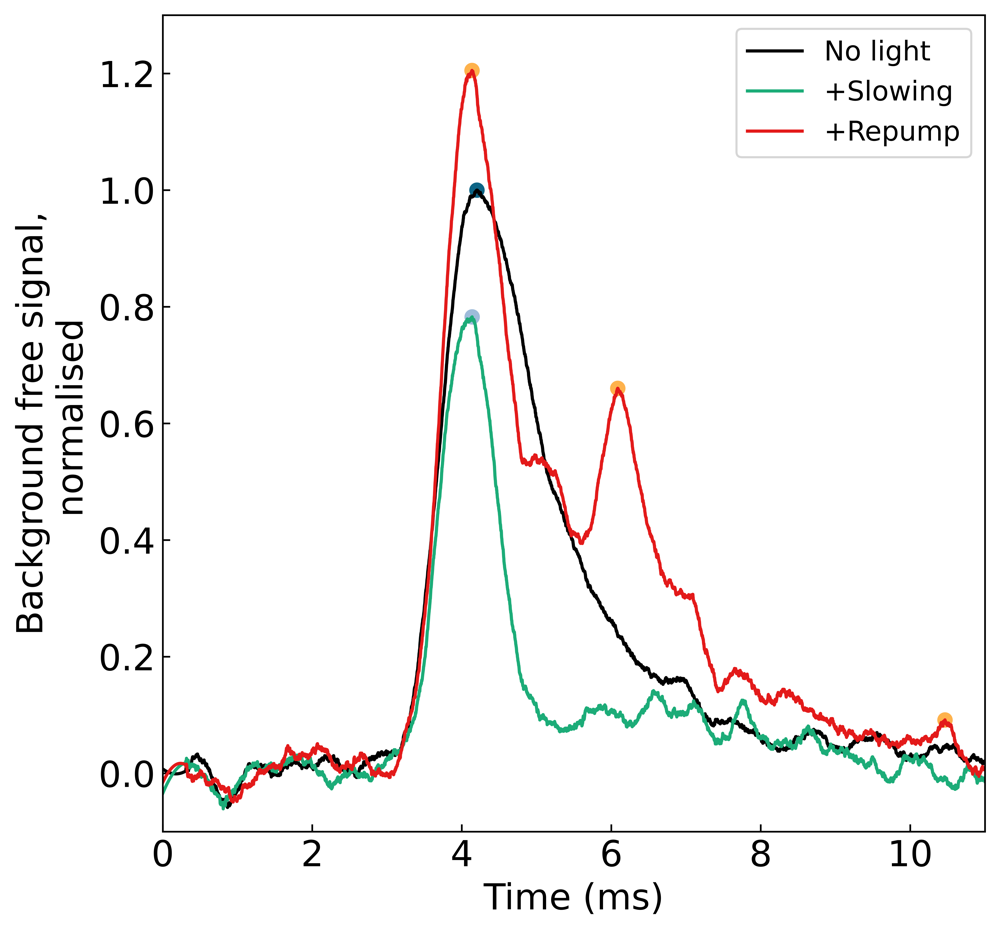
- NowLaser slowing the molecular beamOur first slowing signals are in (right).
- NextMagneto-optical trapCapturing and cooling the slowed molecules.
- FutureMolecules in arrays of lightOptical lattices and tweezers for quantum simulation.
Join us: PhD starting October 2027
We're looking for a PhD student to join the team working towards quantum simulation with a lattice of CaF molecules. This is a hands-on experimental project, and you'll be part of a friendly, close-knit team.
Along the way you'll learn:
- Laser systems, optics and frequency stabilisation.
- Ultra-high vacuum and cryogenic techniques.
- Electronics, experiment control (Artiq) and data analysis (Python).
- Molecular and atomic physics, and quantum simulation.
No previous experience with molecules is needed. Curiosity and enthusiasm for experimental physics matter most. Deadline for application: 15th December 2026
Project details How to apply Life as a QLM studentQuestions? Email Dr Hannah Williams. We're happy to chat informally or show you around the lab.
The team
Former members
- Dr Alex J. Matthies (they/them), PDRA 2023–2026, now a postdoc in Gothenburg
- Tom Philo (he/him), MSci student 2024–2025
- Keelan Sloan and Andrew Elwood, MSci students 2023–2024
- James Crilly, Matthew Page and Yuchao Liu, MSci students 2022–2023
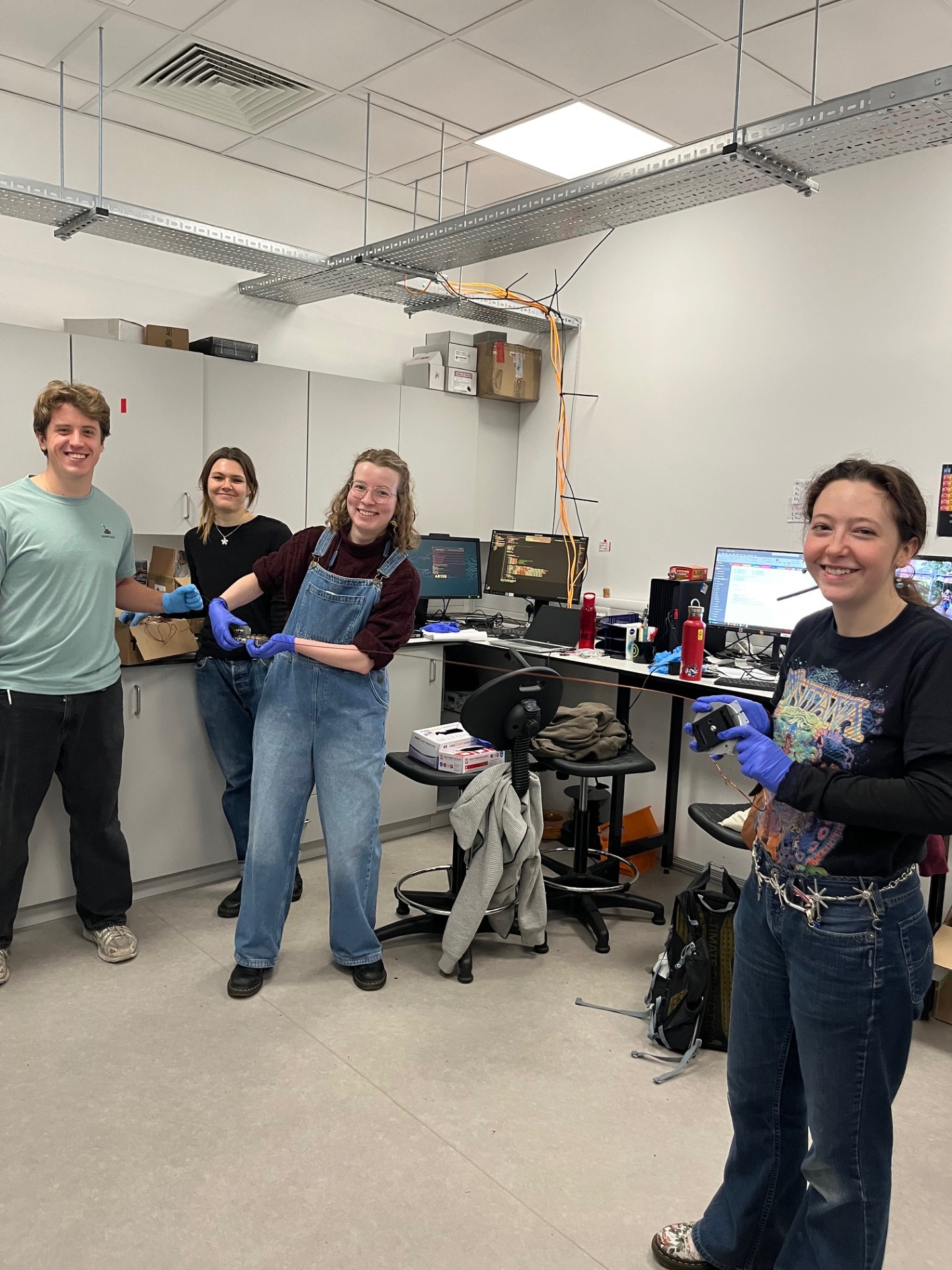
Life in the group

Publications
Journal articles
- Near-deterministic loading of optical tweezer arrays via repulsive barricade potentials (Preprint), arXiv:2604.22406 (2026).
- DiPolMol-Py: A Python package for calculations for 2Σ ground-state molecules, Computer Physics Communications (2025). Journal · arXiv:2503.21663
Theses
- Bethan Humphreys Towards Zeeman-Sisyphus Deceleration of CaF Molecules (2025).
- Hannah Williams Producing, trapping and controlling ultracold CaF molecules (2018)
News
- Nov 2026 We start rebuilding the entire experiment as we change our focus to making a MOT.
- Oct 2026 Lara joins the lab for her PhD, and Nicole returns along with Andreas for MSci projects. Welcome all!
- Sept 2026 We see the first signal of laser slowing!
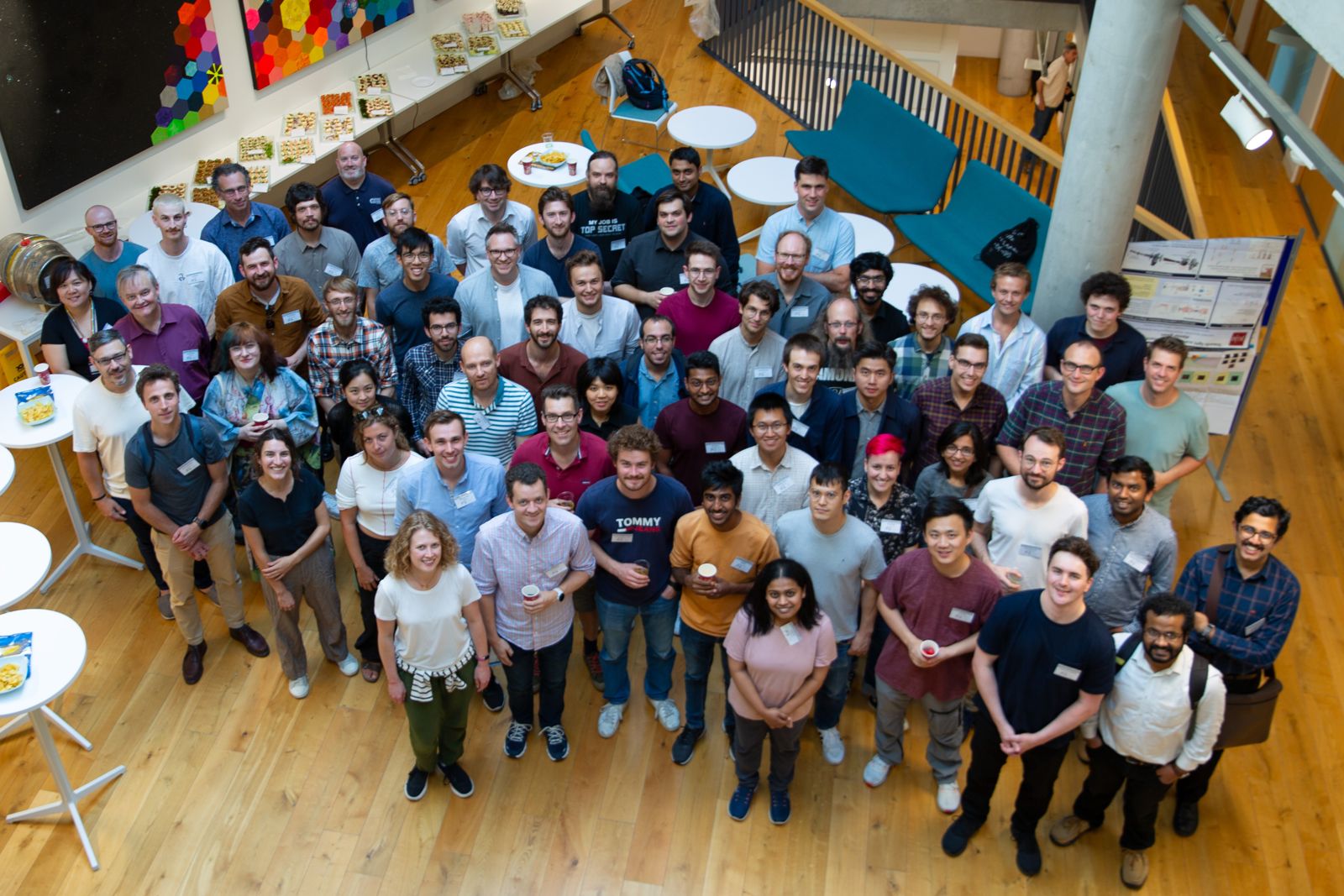
- Aug 2026 The whole team goes to Imperial for the second UK Laser Cooling Molecules meeting. Nicole finishes her summer internship, having set up environmental monitoring for the lab.
- Jul 2026 Bethan and Becca attend the QSMol kick-off meeting. Nicole joins the team for a summer internship. Welcome Nicole!
- Jun 2026 Archie presents a poster at ICAP in Wuhan and at the ultracold molecules satellite meeting in Hong Kong. Alex leaves the group to start a postdoc in Gothenburg. Good luck, and thank you!
- May 2026 We finish the Zeeman-Sisyphus project. Sadly, we saw no deceleration.
- Apr 2026 Our proposal paper on near-deterministic loading of tweezer arrays is on arXiv.
2025
- Sep Hannah returns to work. Bethan and Hannah attend the EPSRC Quantum Technologies Future Leaders Event.
- Aug Our paper DiPolMol-Py: A Python package for calculations for 2Σ ground-state molecules is published.
- Jul Archie presents a poster at ECAMP15 and Becca presents a poster at YAO, both in Innsbruck.
- Jun Tom graduates. Congratulations and best of luck for the future! Bethan presents a poster at ICOLS2025 on the island of Elba, and Alex presents a poster at the Workshop on Ultracold Molecules in Warsaw.
- May Bethan passes her viva! Congratulations, and welcome back as a PDRA, Dr Humphreys!
- Apr Hannah begins maternity leave.
- Mar Becca attends PG Women in Physics. We submit our first paper, and Bethan submits her PhD thesis.
- Jan The whole team heads to Imperial College for the first UK laser cooling molecules workshop.
2024
- Oct Rebecca joins the group for her PhD, and Tom starts his Master's project. Welcome to the team, both! Alex spends three weeks visiting cold molecule labs in the USA.
- Sep Alex and Hannah attend CCMI near Vienna, where Alex presents a poster and Hannah gives an invited talk.
- Jul We host the Dipolar Quantum Matter ICAP satellite meeting, which is a resounding success! Archie presents a poster at the ICAP summer school in Oxford, and Bethan presents a poster at ICAP.
- Jun Alex presents a poster at EGAS in Granada. Keelan and Andrew both graduate. Congratulations and good luck in your future endeavours!
- Apr We see CaF molecules in the lab for the first time!
2023
- Dec Hannah is awarded a UKRI Future Leaders Fellowship for the project Molecules for Quantum Simulation, starting June 2024.
- Nov Bethan gives her first academic talk at the Northern Quantum Meeting IX in Sheffield.
- Oct The team is growing rapidly! Archie Baldock joins as a PhD student, and two MSci students join: Keelan Sloan, working on background-free imaging of CaF, and Andrew Elwood, building a cooled leader-follower laser system.
- Sep Dr Alex Matthies joins the team as a PDRA. Welcome Alex!
- Jul James, Yuchao and Matthew all graduate from Durham University. Congratulations all! Keelan Sloan joins for a summer placement to help build our cryogenic buffer gas source. Welcome to the team, Keelan!
- Jun Bethan presents her first poster at EGAS in Strasbourg.
- Jan Hannah is awarded an EPSRC New Investigator Award to test a Zeeman-Sisyphus decelerator for CaF molecules (April 2023 to September 2025).
2022
- Oct Three MSci students join the group: James Crilly (co-supervised by Dr Carty, simulating the Zeeman-Sisyphus decelerator), and Matthew Page and Yuchao Liu (co-supervised by Prof. Cornish, working on tweezer simulations and creation using a spatial light modulator).
- Sep The lab refurbishment is complete!
- Jul Bethan passes her 9-month progression. Congratulations!
- Feb Bethan attends the Introductory Course on Ultracold Quantum Gases in Innsbruck.
- Jan Work starts on converting office space into our lab.
2021
- Oct The group is formed, and Bethan joins as the first PhD student. Welcome Bethan!
This work is supported by UKRI Future Leaders Fellowship MR/X033430/1. Page design and layout developed with the assistance of Claude (Anthropic), content reviewed by CaF team.