In this project, we are using Rydberg excitons in Cu2O as an interface between microwave and optical frequencies. Cu2O is the classic semiconductor for exciton physics. An exciton is a bound state of an electron and a hole, which can be created optically by illuminating the material with a laser. Just like atoms, the bound states of excitons follow a Rydberg series, defined by the principal quantum number n, as shown below.
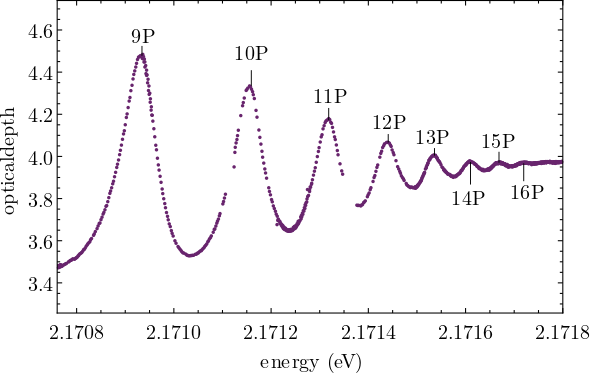
Exciton spectrum showing principal quantum number states as high as *n = 16.*
The spectrum above shows the Rydberg series of exciton resonances in Cu2O. As n increases, the levels become increasingly closely spaced, eventually converging towards the band gap of the semiconductor.
Why are Rydberg excitons so sensitive to microwave fields?
As n is increased, the spacing between neighbouring Rydberg exciton levels enters the microwave frequency regime, allowing a microwave field to drive an electronic transition between exciton states. These microwave-driven transitions can also be extremely strong, as the large spatial extent of Rydberg excitons leads to strong electric dipole transitions between these states.
One of the goals of our research is to exploit these strong microwave transitions for microwave sensing. One advantage of our system is its large bandwidth. The Rydberg exciton lifetime leads to broad exciton lines, giving an almost flat frequency response from < 1 GHz to > 20 GHz.
A hybrid quantum system
Superconducting circuits are a leading platform for quantum computing, with quantum information encoded in microwave-frequency states. Rydberg excitons offer a way of coupling these microwave systems to the optical domain.
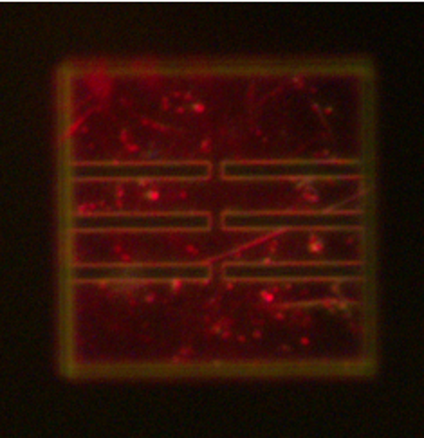
Red Cu2O crystal imaged through a square hole in the ground plane of a superconducting microwave resonator. Dark horizontal bars are three different superconducting microwave resonators.
In our experiments, a high-quality Cu2O crystal is placed on top of a superconducting microwave resonator. The microwave field from the superconducting resonator is designed to penetrate the Cu2O sample, where Rydberg excitons are created with a laser beam, creating a hybrid quantum system of excitons and superconductors. This hybrid system could ultimately provide an optical readout of a superconducting qubit.
Improving optical coupling
An efficient microwave-to-optical converter must optimise both microwave and optical coupling. To investigate how far the optical coupling can be pushed, we are exploring the creation of Cu2O microcavities and the use of nonlinear spectroscopy techniques.
Growing better Cu2O
The quality of the Cu2O crystal is crucial to these experiments. Defects and impurities can broaden and suppress the Rydberg exciton resonances, making them harder to observe and control.
Currently, natural Cu2O crystals provide the highest quality material. For Rydberg excitons to be useful for quantum technologies, we must also be able to produce high-quality synthetic material. Working with collaborators in the UK and abroad, we are exploring different growth techniques to improve the quality of synthetic Cu2O.
Interested in working on this research?
We are always interested in hearing from motivated students and researchers interested in quantum optics, condensed matter physics, and superconducting circuits.
Contact m.p.a.jones@durham.ac.uk to find out more.
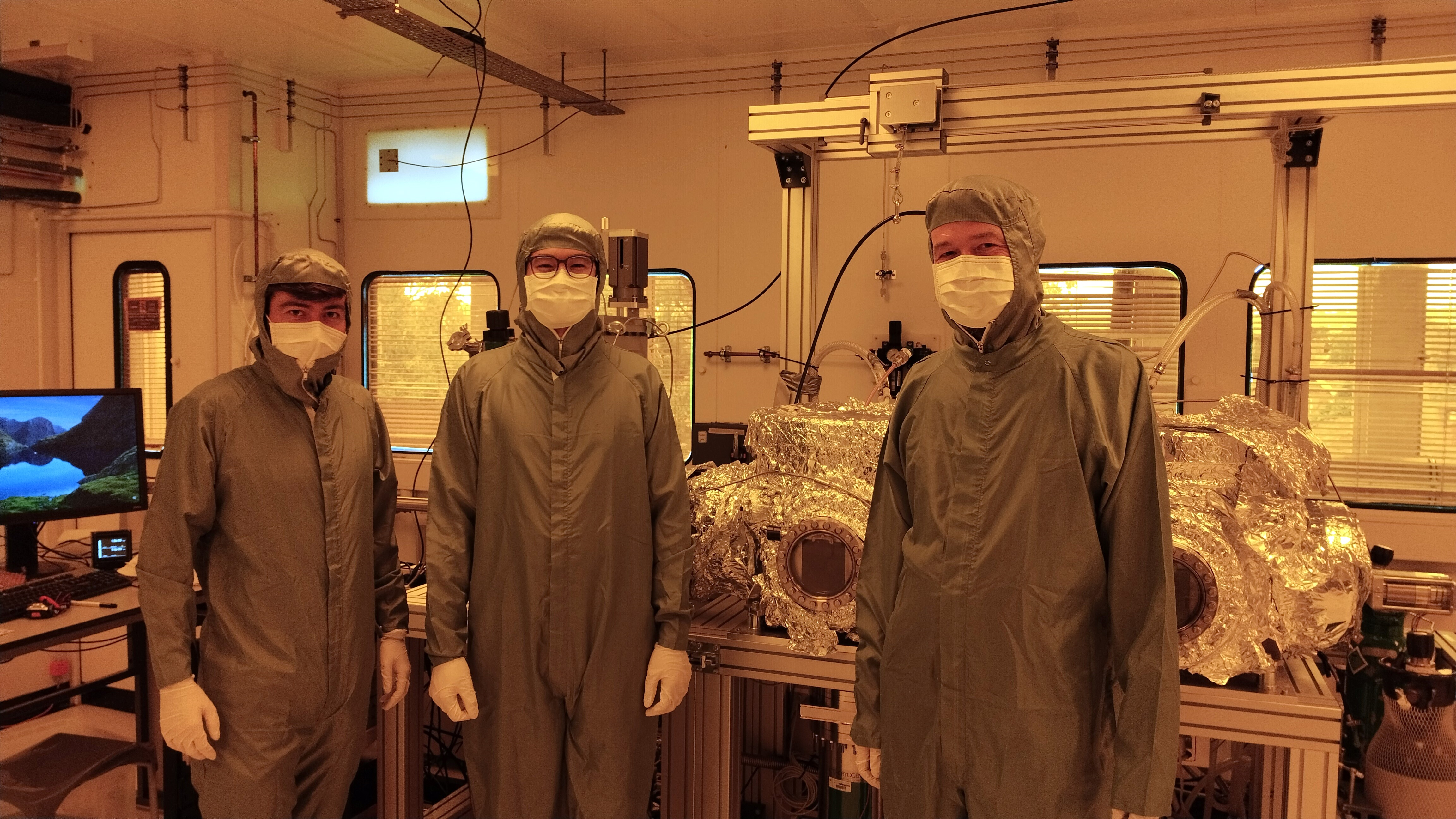
Our recent visit to the University of Cardiff.
Team members
Prof. Matthew Jones (Principal investigator)
Dr. Liam Gallagher (Reseracher co-investigator)
Dr. Krzysztof Sawicki (PDRA)
Madeleine Fisher (PhD Student)
Former members
Dr. Qin Xi (Horatio) Wong (PhD student)
Dr. Alistair Brewin (Former PhD student)
Dr. Jonathan Pritchett (Former PhD student)
Dr. Joshua Rogers (Former PDRA)
Collaborators
Cardiff University
Prof. Stephen Lynch
Prof. Wolfgang Langbein
Prof. Simon Doyle
University of St Andrews
Publications
[1] Microwave-optical spectroscopy of Rydberg excitons in the ultrastrong driving regime
Brewin, A., Gallagher, L. A., Pritchett, J. D., Wong, H. Q., Potvliege, R. M., Clark, S. J., & Jones, M.
New J. Phys. 26 113018 (2024)
[2] Giant microwave–optical Kerr nonlinearity via Rydberg excitons in cuprous oxide
Pritchett, J.D., Gallagher, L.A., Brewin, A., Wong, H.Q., Langbein, W., Lynch, S.A., Adams, C.S. and Jones, M.
APL Photonics 9 (3): 031303 (2024)
[3] Microwave-optical coupling via Rydberg excitons in cuprous oxide
Gallagher, L., Rogers, J., Pritchett, J., Mistry, R., Pizzey, D., Adams, C., Jones, M., Grünwald, P., Walther, V., & Hodges, C.
Phys. Rev. Research 4, 013031 (2022)
[4] High-resolution nanosecond spectroscopy of even-parity Rydberg excitons in Cu 2 O
Rogers, J., Gallagher, L., Pizzey, D., Pritchett, J., Adams, C., Jones, M., Hodges, C., Langbein, W., & Lynch, S.
Phys. Rev. B 105, 115206 (2022)
[5] Rydberg excitons in synthetic cuprous oxide Cu 2 O
Lynch, S., Hodges, C., Mandal, S., Langbein, W., Singh, R., Gallagher, L., Pritchett, J., Pizzey, D., Rogers, J., & Adams, C.
Phys. Rev. Materials 5, 084602 (2021)
PhD Theses
Qin Xi (Horatio) Wong: Microwave-to-optical Conversion via Rydberg
Excitons in Cu2O (2026)
Jon Pritchett: Microwave Induced Optical Nonlinearities in Cuprous Oxide (2023)
Liam Gallagher: Optical and microwave spectroscopy of Rydberg excitons in Cu $ _2 $ O (2022).
Funding
This research is supported by EPSRC through EP/X038556/1.